AI Cracks an 87-Year-Old Math Problem in One Evening – and the Recipe Works for Your Business Too
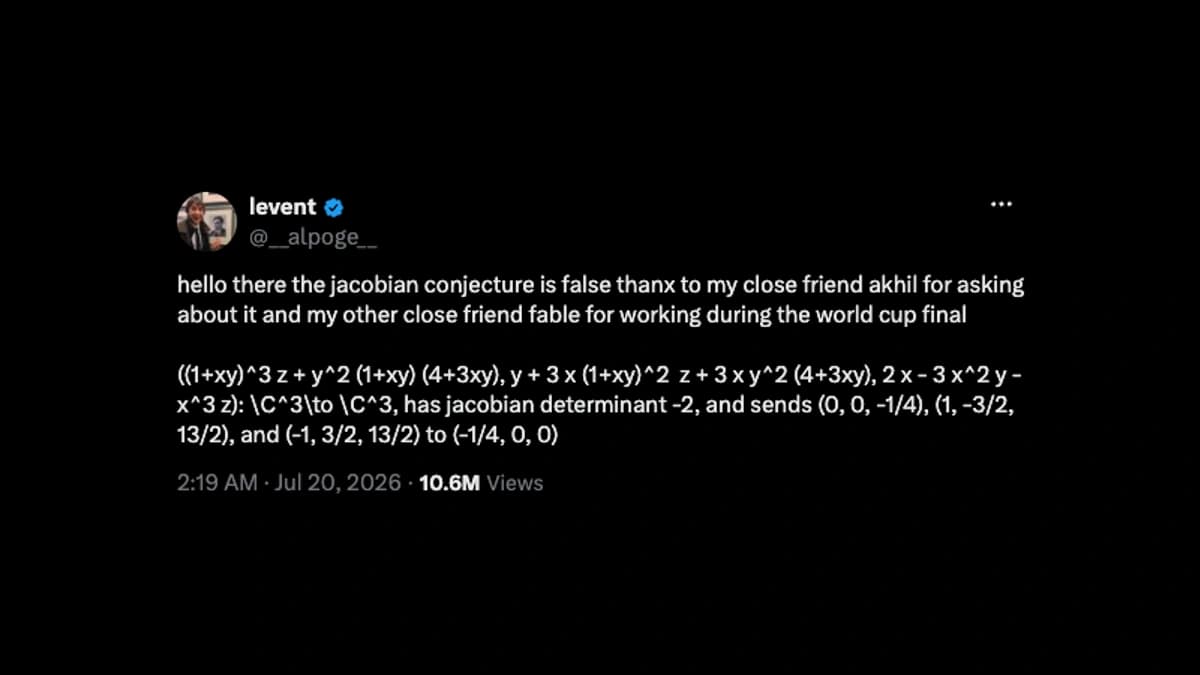
On the night of July 19–20, 2026 – while the world was watching the World Cup final – mathematician and Anthropic researcher Levent Alpoge published an unassuming post on X: the Jacobian conjecture is false. A fellow mathematician had asked him about the problem, and Claude Fable 5 delivered the counterexample "during the World Cup final". The problem had been open since 1939. Some of the world's best mathematicians spent 87 years on it – and several published proofs later turned out to be wrong.
The post has since passed ten million views. And the most remarkable part isn't that an AI cracked a famous problem – it's how it happened.
What Is the Jacobian Conjecture?
The conjecture goes back to mathematician Ott-Heinrich Keller, who formulated it in 1939. Put simply, it concerns maps built entirely from polynomials – the most basic building blocks of algebra: addition, multiplication, powers.
Every such map has a characteristic quantity called the Jacobian determinant. The conjecture states: if this quantity is a constant number other than zero, the map must be invertible – every output belongs to exactly one input, and nothing gets "folded together".
That sounds harmless, but it proved to be one of the most stubborn problems in algebra. It appears on Steven Smale's famous list of mathematical problems for the 21st century, and the literature is full of failed proof attempts – including some by renowned mathematicians.
What Claude Found
Claude didn't prove the conjecture – it disproved it, with a concrete counterexample. It's a map taking three variables (x, y, z) to three values:
- First component: (1+xy)³·z + y²·(1+xy)·(4+3xy)
- Second component: y + 3x·(1+xy)²·z + 3x·y²·(4+3xy)
- Third component: 2x − 3x²y − x³z
This map has constant Jacobian determinant −2 – so it satisfies the conjecture's premise exactly. And yet it is not invertible: the three distinct points (0, 0, −1/4), (1, −3/2, 13/2), and (−1, 3/2, 13/2) all land on the same output (−1/4, 0, 0). Three inputs, one output – precisely what the conjecture said could never happen. So the conjecture is false.
We Checked It Ourselves
This is what separates the story from the usual AI headlines: you don't have to take anyone's word for it. The counterexample is a public formula, and checking it consists of finitely many exact calculations.
We did it ourselves before writing this article – a few lines of computer algebra, under a minute:
- Jacobian determinant of the map: −2, constant. ✓
- (0, 0, −1/4) maps to (−1/4, 0, 0). ✓
- (1, −3/2, 13/2) maps to (−1/4, 0, 0). ✓
- (−1, 3/2, 13/2) maps to (−1/4, 0, 0). ✓
Four calculations, no room for interpretation. For context: formal peer review is still pending, and the mathematical community is examining the result worldwide right now. But because the check is pure arithmetic, anyone can run it themselves – a completely different situation from a hundred-page proof that only a handful of specialists understand.
The Real Lesson: the Recipe
Everyone is talking about how smart AI has become. We find something else more interesting – how this result came about:
- An expert asked one clear, precise question: not a vague "solve mathematics", but a sharply defined problem, posed by someone who understands it deeply.
- The answer could be checked – not just admired: the value of the result doesn't depend on trusting the AI, but on a verification that works independently.
- No secret lab experiment: Claude Fable 5 is the same model any business can use today via Claude.ai or the API.
Question, verifiability, availability – that's the whole recipe. It works for a world-famous math problem. And it works for your quotes, reports, and contracts.
What This Means for Your Business
Most companies don't have a technology problem with AI – they have an implementation problem. The tools are ready; the questions often aren't.
Translated into everyday business, the recipe reads:
- Sharp questions instead of vague requests: "Check this contract for deviations from our standard clauses" beats "have a look at the contract" – every single time.
- Results you can verify: good AI workflows deliver answers with sources, reasoning, or an audit trail – so a human can check them in minutes instead of accepting them blindly.
- Expertise remains the lever: the best model is worth little without the person who knows which question is worth asking. AI doesn't replace domain knowledge – it multiplies it.
This is exactly the principle behind how we build AI solutions for businesses: precisely scoped use cases, verifiable results, measurable value – instead of AI for its own sake.
Want to know which sharp questions are hiding in your processes? Book a free introductory call →
Further Reading
- Claude Fable 5 Is Here: Anthropic's Most Powerful AI Model
- What Is Claude? Anthropic's AI Assistant Explained
- Why 90% of Companies See No ROI From AI
Sources
AI for Your Business
Want to use Claude in your business?
We integrate Claude, Microsoft 365, and AI workflows securely into your work environment — from strategy to implementation.
Book a Free Consultation30 min · Free · No obligation
Not ready for a call? Take the AI Check — 8 minutes
More Articles
AI potential analysis: see in 30 seconds where AI pays off most for your company
Mert Bacak · 13 October 2026
OpenAI halts and slows frontier AI training – what SMEs should learn for their own AI agents
Daniel Da Cruz · 5 October 2026
New Copilot Business Licences Now Bill by Usage – the Settings to Check
Mert Bacak · 30 September 2026