
Case Study
Digital expert planning for loss assessments
Development of a web solution for the simplified planning and coordination of experts assessing weather-related agricultural damage.
The value created
Relieving users
and leveraging data.
The introduction of the “Expert Planner” marked a significant step in the client's digitalisation strategy. It made planning and coordinating experts for assessing weather-related agricultural damage more efficient and straightforward, while significantly improving access to process- and future-relevant data.
Access to valuable data
Expert data such as expertise, languages, and place of residence is now centrally accessible and filterable.
Fewer calls and less administration
Availability no longer has to be requested individually by phone and tracked by hand.
Greater visibility
Responses, pending replies, and planning status are centrally available at a glance.
Easier participation without a login
Experts respond through a personal link. No registration or login required.
Starting point & problem
Coordination with a high manual workload
When experts need to be scheduled following a claim, availability must be clarified quickly and reliably. Previously, much of this coordination happened by phone: people were contacted individually, responses were tracked by hand, and those who could not be reached were called again and again.
Before the first call could even be made, however, came the selection itself. For every assignment, it had to be checked manually who was eligible at all:
- Technical fit: Does the person have the expertise to assess the damaged product?
- Language: Do they speak the customer's language?
- Reachability: Is the site of the incident logistically feasible for them to reach?
This information was scattered and had to be gathered anew for every request. As the number of dates and participants increased, so did the administrative workload – with no central view showing who had responded and on which days they were available.
How it came to life
From a well-understood problem to a productive tool
Our four-phase approach (Consulting & Analysis, Concept, Development, Launch & Support) provided the framework for this project.
Requirements engineering: understanding everyday work
The project began with a focus on problem analysis. Together, we examined the existing phone-based process, the roles involved, exceptions, and the information flows that mattered most, in order to identify pain points and gain points.
From process to hand-drawn sketches
Building on phase 01, the first workflows for a possible solution were deliberately created with pen and paper. This allowed variants to be compared quickly, unnecessary steps to be removed, and a shared understanding to emerge — without wasting valuable project time.
Lo-fi prototyping: testing workflows
The sketches were developed into clickable wireframes. The focus was on end-user acceptance of the user flow as well as the information architecture.
Hi-fi prototyping: refining the interface
The validated workflows received an interface consistent with the customer's brand guidelines. Status, responses, and next actions were designed to remain easy to understand even across many requests.
Engineering, testing & iteration
Frontend, application logic, data storage, and communication were brought together step by step. Automated tests continuously safeguarded key functions and workflows. A small test group also evaluated the solution under realistic conditions, with feedback on usability and process clarity feeding directly into further iterations.
From go-live to continuous improvement
Following technical quality assurance, practical testing, and business acceptance, the solution was introduced into daily work in a controlled manner. Insights from ongoing use continue to guide targeted optimisation and further development.
Solution concept
From request to planned deployment
One continuous process replaces repeated individual coordination and keeps everyone up to date.
Create a survey
The date range and required experts are assembled centrally.
Invite by SMS
Selected experts receive a direct availability request.
Respond on mobile
Availability is submitted through a personal link without signing in.
Consolidate responses
Responses and pending replies are made visible in one place.
Finalise deployment
Suitable experts are selected, booked, and receive a confirmation.
Implementation
A clear architecture for two usage contexts
Technically, this is a full-stack web application end to end: a protected portal for dispatchers and a deliberately streamlined mobile response process for experts both draw on the same logic and the same data.
Behind the scenes, a shared application logic keeps the planning status consistent, sends invitations automatically by SMS, and stores every response in a structured, durable way.
Simplified solution architecture
Two focused interfaces work with one shared, consistent planning status.
- DispatchProtected portal for selection and planning.
- Mobile ResponsePersonal link, no registration and no login.
- Application LogicKeeps the planning status consistent and controls access.
- SMS ServiceSends invitations and confirmations automatically.
- Data StorageStores every response in a structured, durable way.
Technologies Used


The result
Two interfaces, one shared process
Dispatchers gain overview and control. Experts only see what they need to respond quickly.
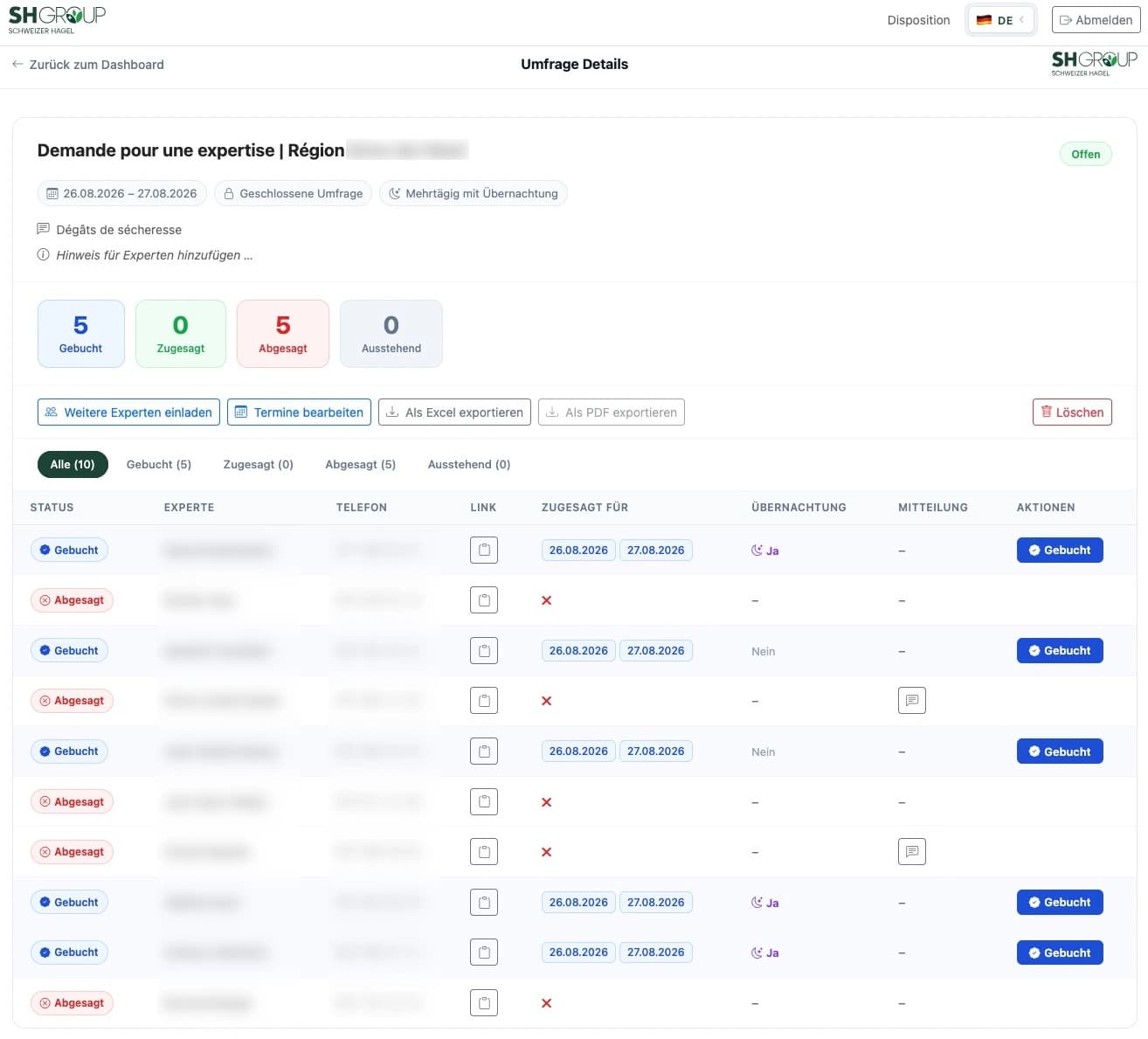
Product view with anonymised sample data
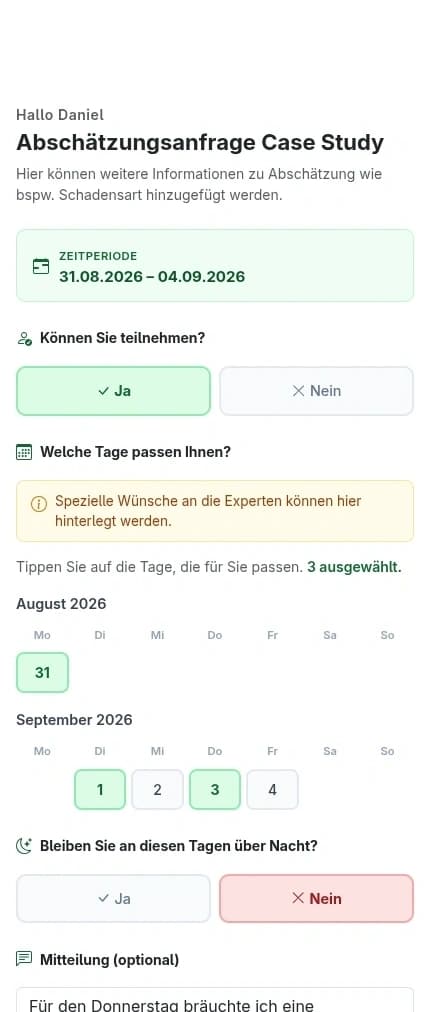
Mobile response view
Your processes. Your solution.
Where does manual coordination cost your business time?
We combine consulting, UI/UX, and software engineering into a solution designed around your everyday work.
Discuss your project